Key takeaways
- Kirkwood's crashes cluster on Lindbergh, the I-44 ramps, Manchester at rush hour, and the school roads on a schedule.
- Most are low-speed. Low speed plus surprise is exactly the recipe for whiplash and delayed soft tissue pain.
- The desk's mail follows one pattern: minor crash, fine at the scene, pain by day three, exam a month late.
- Tesson Ferry is a straight run south on Lindbergh from the depot. Hazelwood and O'Fallon cover the north and west.
- Serious crashes belong to the emergency room. The line is printed on this page.
Kirkwood is a slow town in a fast frame. Downtown is two-story brick, a limestone depot, and streets that were laid out for wagons. Around that, and sometimes right through it, runs a set of roads built for a different century: Interstate 44 along the south edge, Lindbergh Boulevard cutting north to south and wearing the name Kirkwood Road while it passes the shops, Manchester Road along the north, Big Bend angling through the middle, and I-270 a few minutes west. The crashes this Journal hears about happen on those roads, and they happen in predictable ways.
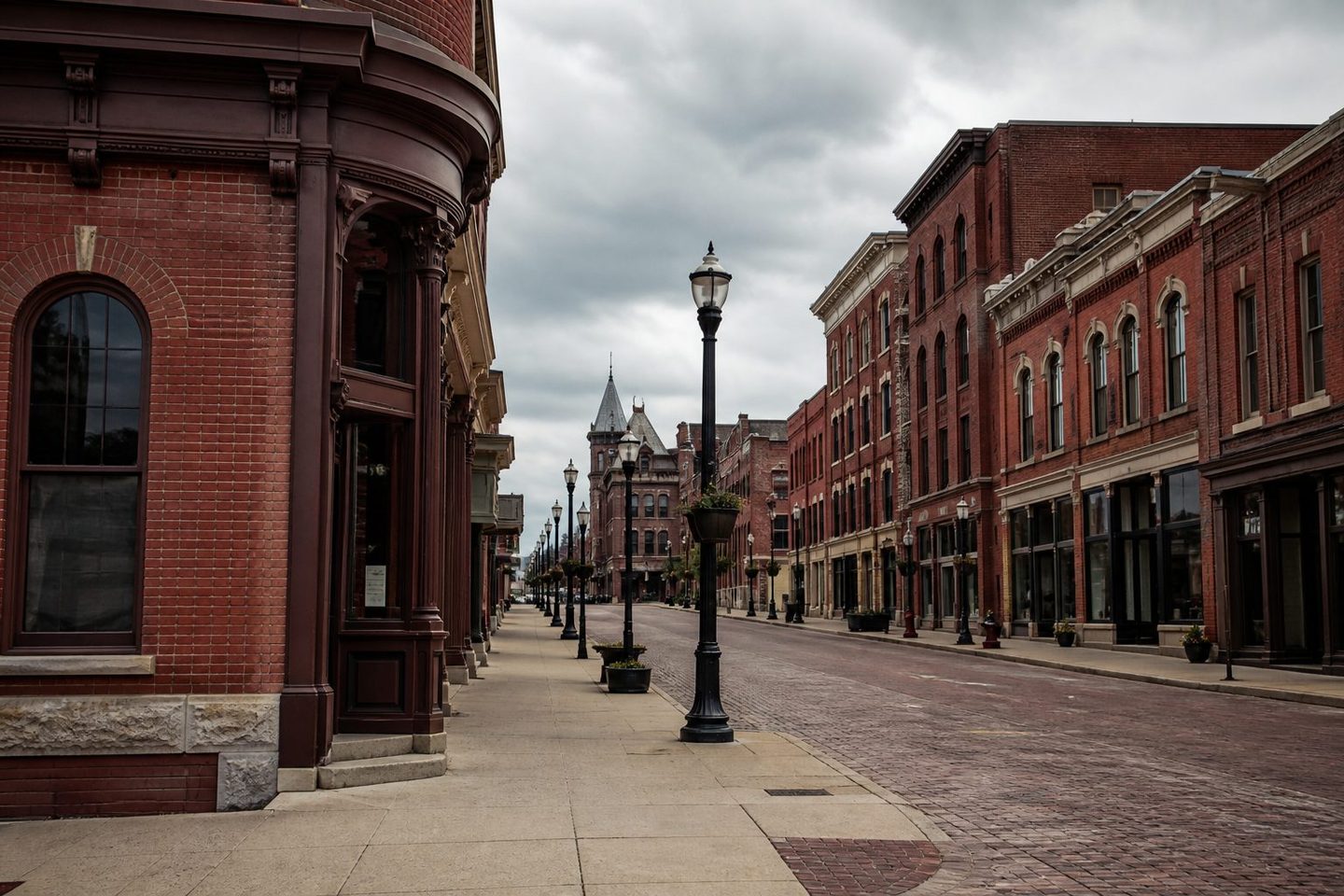
Lindbergh, which is Kirkwood Road for a while
Lindbergh is the spine. Through downtown it is Kirkwood Road, four lanes of shops, turn lanes, and pedestrians at the Argonne and Jefferson crossings, and the crashes there are low-speed and frequent: a left turn across traffic misjudged, a rear-end at a light that changed faster than the driver expected. South of I-44 it opens up and the speeds rise with it. The same road that produces a fifteen-mile-an-hour tap downtown produces a forty-mile-an-hour rear-end near the interstate ramps.
For this Journal's purposes Lindbergh matters twice. It is where a good share of readers get hit, and it is the road that carries them to the exam. Missouri Injury Clinic's Tesson Ferry office is a straight run south on Lindbergh, roughly fifteen minutes from the depot outside rush hour.
I-44 and its ramps
The interstate itself is fast and mostly straight through this stretch, and the serious crashes on it tend to be the ones the emergency room handles. The ramps are another story. The Lindbergh and Big Bend interchanges merge slow traffic into fast traffic over short distances, and the characteristic wreck is a driver braking for a gap being hit from behind by a driver who was looking at the gap too. Nobody is going very fast. Everybody's neck is.
Whiplash, in plain terms, is a neck strain from the head whipping back and forward faster than the muscles could brace. It does not need a high speed, it needs a surprise, and a ramp merge is a machine for producing surprises. The Journal's three days later essay explains why the pain from that kind of hit tends to show up on a delay.
Manchester and the commute
Manchester Road runs east to west along the top of town and through Des Peres, Glendale, and on toward Brentwood. At rush hour it is a chain of signals and a line of cars that stops and starts in waves, and the rear-end hit in that line is the most ordinary wreck in the county. The Journal keeps a separate entry on it, The Manchester Road commute, because ordinary deserves its own plan.
Big Bend, Geyer, and the school roads
Big Bend carries traffic past the college and the high school and into Webster Groves, and Geyer runs the other way past more schools. The crashes here have a schedule: the morning drop-off, the afternoon pickup, the Friday night game letting out. Speeds are low and the drivers are often young or distracted, which is a polite way of saying that the parent who gets tapped at a crosswalk at 3:15 is a reader of this Journal whether they expected to be or not.

What the desk hears
The pattern in the Journal's mail is consistent. The crash was minor. The driver was fine at the scene. The neck or back arrived two or three days later. A head that felt "a little off" turned into a week of fog. The reader waited because the crash was minor, and by the time they called, they were describing a month rather than a week.
None of that is a scandal. It is what soft tissue and mildly rattled brains do, and public health agencies describe the same delayed course. The CDC's HEADS UP program is plain that concussion symptoms can appear hours or days after the hit, and the National Institute of Neurological Disorders and Stroke describes mild TBI the same way. The fix is not to treat every tap as a catastrophe. The fix is to treat every tap as worth an exam this week, so that the week is measured rather than remembered.
The roads are fast and the town is slow. Let the exam be the one thing that happens on time.
Where the clinic is, relative to all of this
Tesson Ferry, south on Lindbergh, is the near office for anyone in Kirkwood, Glendale, Des Peres, Webster Groves, Oakland, or Warson Woods. For a reader who was hit on I-270 heading north toward the airport, the Hazelwood office at 14 Village Square Shop Ctr may be the shorter drive. For a reader whose commute crosses the Missouri River, the O'Fallon office at 2163 West Terra Lane is the western option. Phone numbers and hours are on the offices entry. Every office closes from 12 to 2.
The one action
Hit on one of these roads? Get examined this week.
Tesson Ferry is a straight run south on Lindbergh. Say it was a crash, name the road, and ask for an exam this week.
Tesson Ferry office · 11144 Tesson Ferry Rd, Suite 200
Mon to Thu 9 to 6, Fri 9 to 12, closed 12 to 2
The emergency line, first. Chest pain, a sudden severe headache, weakness or numbness on one side, trouble speaking, a loss of bowel or bladder control, or a head injury with vomiting or worsening confusion is an emergency room trip right now, not a call to a clinic.
Advertising disclosure. This page is advertising. This desk is compensated for featuring Missouri Injury Clinic, and it is not the clinic, not a law office, and not a party to anyone's insurance claim. We publish only the lanes, offices, and hours the clinic publishes on moinjuryclinic.com. We do not write reviews, rank providers, or give medical or legal advice.
Educational reading. Not medical advice, not a diagnosis. The Journal cannot examine anyone.